

The release of Consumer Price Index data for June 2026 shows a slight fall in the inflation rate.
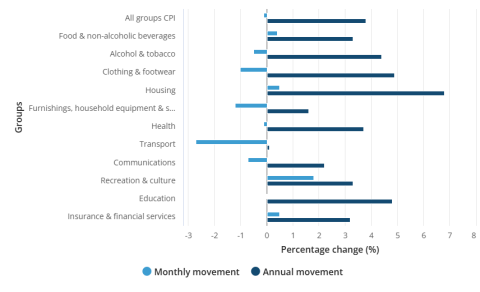
Nationally, prices fell a little between May and June this year (-0.1%), but over the past year prices are up 3.8%. This is down from 4.0% in May, and a sign that the three interest rate rises the Reserve Bank made earlier this year are continuing to constrain demand across the economy.
Even so, the Australian economy is still some way from the Reserve Bank’s target band for inflation of between 2-3%.
Construction businesses continue to bear the brunt with housing remaining one of the main drivers of the elevated inflation rate.
Housing (+0.5%) saw the largest rise in June and over the previous year from June 2025, housing (+6.8%) and Clothing & Footwear (+5.0%) again, saw the biggest annual rises in inflation.
The biggest contributors to high housing inflation were increased electricity prices and increased prices for new dwellings which rose by 5.8% in the 12 months to June 2026, up from a 5.6% rise to May 2026. The increased cost of building products and services and labour were the main factors driving up the cost of new homes.
Rental inflation also remains stubborn with a 3.6% increase over the year to June 2026.
On a positive note, transport costs decreased by 2.6% in May and June. However, hostilities continuing in the Middle East uncertainty continues around fuel prices in coming months.
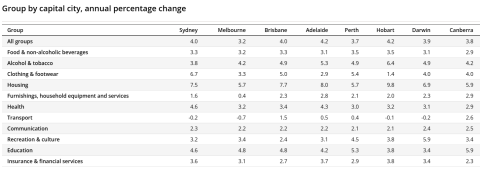
Of the capital cities annual inflation rates Sydney (4%) sits in the middle band with Melbourne (+3.2%) and Perth (+3.7%) being the lowest and Adelaide and Hobart the highest at 4.2%.
All groups CPI and Groups, monthly and annual movements (%)
|
Image
|
|
Image
|